
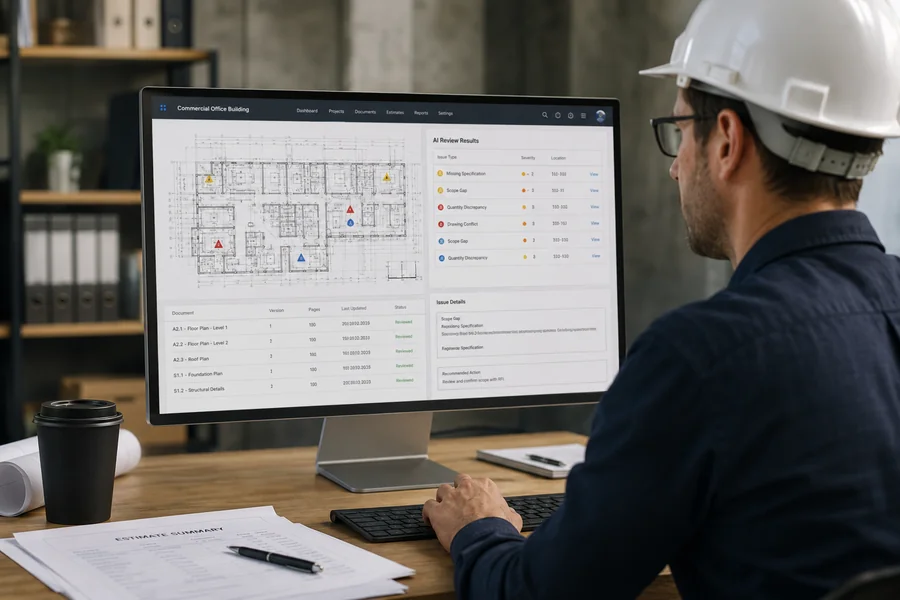
Construction estimating has never been only about counting materials or filling out a spreadsheet. It is one of the first places where risk becomes visible, long before crews arrive on-site or a project manager starts dealing with the fallout. A contractor may have accurate quantities and still carry exposure if the scope is incomplete, the drawings conflict with the specifications, or a late addendum changes the work right before bid day.
That is where AI construction estimating software is earning serious attention. Contractors are not just looking for faster math. They want a clearer read on the full bid package, fewer missed items, better scope notes, and stronger confidence before submitting a number. In a market where labor is tight, documents are dense, and bid windows keep shrinking, the value is not hype. It is a sharper review.
The best tools support the estimator rather than replacing that person’s judgment. Human expertise still drives pricing, labor strategy, exclusions, assumptions, trade coordination, and final bid decisions. AI adds a second layer of document review, helping teams see more of the project before they commit. That extra visibility can lead to cleaner proposals, fewer surprises, and better conversations with owners, general contractors, and internal teams.
What AI Estimating Tools Actually Improve
The strongest AI estimating tools improve the messy middle of preconstruction. That is the space between receiving bid documents and turning them into a number the company can defend. It includes reading drawings, comparing notes, checking specifications, tracking addenda, reviewing schedules, and identifying areas where the scope is unclear or incomplete.
Traditional takeoff tools still play an important role. Contractors need accurate measurements, quantities, assemblies, and cost inputs. A solid takeoff platform can help organize that work, especially when teams are dealing with repetitive scopes or large plan sets. The larger issue is that many bid problems are not caused by bad counting. They are caused by missed context.
AI helps by reviewing information across the bid package instead of treating each sheet as an isolated item. It may flag a note that conflicts with a detail, a spec requirement that was never included in the estimate, or a revision that changes the scope late in the process. Those findings do not make decisions for the estimator. They give the estimator better material to judge.
The practical gains often show up in a few important areas:
- Faster document review across drawings, specs, schedules, and addenda.
- Better visibility into scope gaps, inconsistencies, and unclear requirements.
- Stronger notes that support internal review, proposal writing, and project handoff.
For contractors, that means AI estimating platforms are less about replacing work and more about strengthening the work that already happens. The estimator still owns the final number. The software helps make sure fewer details get buried before that number goes out.
Scope Review Is Where Bid Risk Usually Hides
Many estimating problems begin before pricing ever happens. A requirement may be buried in a specification section that few people have time to read line by line. A detail may imply work that is not obvious from the main plan. A schedule may list an item that appears nowhere else, or an addendum may change a material, quantity, phasing note, or responsibility after the team already started building the bid.
That is the pressure contractors face on real projects. Information is spread across drawings, notes, details, schedules, specifications, alternates, allowances, and revisions. Estimators are expected to interpret all of it while also coordinating subcontractor coverage, checking exclusions, reviewing alternates, answering questions, and meeting submission deadlines. Even experienced teams can miss something when the documents are unclear or the bid calendar is overloaded.
Scope review is hard because construction documents do not always tell a clean story. The drawing set may say one thing while the specs say another. A responsibility may be implied instead of stated directly. One trade may assume another trade is carrying an item, creating a gap that does not appear until the project is active.
A better estimating process gives teams a way to catch these issues earlier. It does not remove the need for skilled review, but it gives that review more structure. Contractors need to know what is included, what is implied, what is missing, and what deserves clarification before the proposal is submitted.
That kind of clarity can affect more than the bid itself. It can influence how a company communicates with prospects, writes project pages, explains its process, and positions its expertise online. A contractor who deeply understands risk and scope has a story worth telling. The challenge is turning that operational strength into language buyers can understand.
How AI Helps Contractors Catch More Before Bid Day
AI-driven plan review can help contractors reduce missed items by enabling more consistent document scanning. Manual review depends on time, experience, attention, and workload. Even a sharp estimator can overlook something when multiple bids are moving at once, drawings are revised late, or a project has dozens of details spread across the set.
The value comes from comparison. AI can scan across drawings, specifications, schedules, and addenda to identify areas that deserve closer attention. It may point out that a note mentions a product requirement not reflected elsewhere. It may flag a revised sheet that affects a quantity. It may find a scope item that appears in one document but not in another.
The goal is not to flood the estimating team with noise. A useful system should organize findings in a way that helps people act quickly. Estimators need to see where an issue originated, decide whether it affects the estimate, and turn that decision into the next step. That next step might be an RFI, an allowance, a revised quantity, a subcontractor clarification, or a proposal exclusion.
Good review also helps teams work together with less friction. Senior estimators can focus on judgment rather than manually hunting for every note. Junior team members can learn from flagged issues and source references. Project managers can receive better handoff notes if the bid is awarded.
The strongest results usually come from pairing AI with a disciplined estimating culture. The software can surface potential gaps, but the team still needs a process to review them. Contractors should decide who reviews findings, how decisions are documented, and how those decisions are incorporated into the final proposal.
A practical workflow may include:
- Reviewing AI findings before final pricing meetings.
- Turning confirmed issues into RFIs, exclusions, allowances, or scope notes.
- Keeping a record of major assumptions so project teams are not left guessing after award.
That structure can reduce chaos near the deadline. It also helps the company build a repeatable process, which matters as bid volume grows.
Features Contractors Should Look For In AI Estimating Platforms
Contractors should judge estimating software based on practical outcomes, not broad automation claims. A clean interface is helpful, but it is not enough. The tool needs to improve how the team reviews scope, checks changes, prepares proposals, and protects margin. Pretty dashboards mean little if the system cannot help an estimator find the details that affect the bid.
Strong document intake is a core requirement. Teams should be able to upload and organize drawings, specifications, addenda, schedules, and supporting files without creating extra admin work. If setup takes too long, estimators may avoid the tool during busy bid weeks. Good software should fit the pressures of real estimating, not just perform well in a controlled demo.
Cross-document comparison is also important. Many scope issues only become apparent when information from multiple sources is read together. A sheet note might not look important until it is compared with a spec section. An addendum may seem small until it changes a schedule or detail that affects pricing.
Prioritized findings matter as well. Estimators do not need a giant list of vague warnings. They need clear issues with enough context to check quickly. The best findings are tied back to source documents, allowing the team to verify the issue and make a decision without wasting time.
Version tracking should be part of the evaluation. Revised sheets and addenda can change the bid late in the process, and outdated assumptions can easily carry into the final number. A strong platform should help teams see what changed and where those changes may affect scope.
Contractors should also think about workflow fit. Most companies already rely on spreadsheets, takeoff tools, bid tabs, cost history, vendor quotes, and internal review habits. AI should support that environment rather than forcing a full rebuild. The right tool feels like a smarter layer inside the estimating process, not a separate universe the team has to babysit.
Key features worth checking include:
- Full bid package review across drawings, specs, schedules, and addenda.
- Source-linked findings that help estimators verify issues quickly.
- Version comparison highlighting meaningful changes in the revised documents.
- Exportable notes for RFIs, proposals, internal meetings, and project handoff.
Better Bids Also Need Better Sales And Marketing Support
Better estimating can make a contractor more competitive, but that advantage should not stay hidden inside the office. If your team has a strong preconstruction process, buyers should understand it before they ever request a proposal. A contractor’s website, SEO strategy, case studies, and service pages should make that expertise visible in plain language.
Many construction companies talk about quality, experience, and service. Those claims are common, which makes them easy to ignore. A stronger message explains how the company works, where it reduces risk, and what clients can expect from its process. Estimating discipline is part of that story because it shows that the company thinks carefully before the work begins.
This is especially useful for service businesses, subcontractors, general contractors, and specialty trades competing in crowded local markets. The company that clearly explains its process often feels more credible than the company that only lists its services. Search-friendly content can help answer buyer questions, support sales conversations, and bring in more qualified leads.
Contractors can strengthen their marketing with content that covers:
- How the company reviews project scope before pricing.
- What clients should know before requesting a bid.
- How the team handles changes, documentation, and communication.
- Why better planning can reduce confusion once work begins.
This type of content does not need to sound stiff or overproduced. It should sound like an experienced contractor talking to a serious buyer. Clear language builds trust, and trust helps turn interest into real conversations.
How Stronger Bid Defense Protects Margin
A bid is more than a price. It is a position the contractor may need to explain to owners, general contractors, subcontractors, project managers, and internal leadership. Strong bid defense depends on clear documentation, sound reasoning, and the ability to show how the team interpreted the scope.
AI construction estimating software can support that defense by helping teams document what was reviewed, which issues were found, and how those issues were handled. When findings are connected to drawings, specifications, or revisions, the estimating team can explain decisions with more confidence. That clarity can make proposal conversations less reactive and more controlled.
This also improves handoff after award. Project managers benefit when the estimate includes clear assumptions, exclusions, and known risks. Subcontractor scope review becomes easier when potential gaps have already been identified. Internal meetings are more productive when the team works from documented information rather than relying on memory.
Margin protection is one of the biggest reasons contractors care about better review. Missed scope can lead to disputes, rework, strained relationships, and unplanned costs. A cleaner process gives the company a better chance to price the job accurately and communicate the bid with less confusion.
There is also a reputational benefit. Contractors that submit clear, thoughtful proposals often stand out, even when they are not the cheapest option. Buyers notice when a team has done the work, asked sharp questions, and documented the details. That kind of professionalism can become part of the company’s brand.
Frequently Asked Questions About AI Estimating Tools For Contractors
What Is AI Construction Estimating Software?
AI construction estimating software helps contractors review drawings, specifications, schedules, addenda, and bid documents with more consistency. It can support takeoff, flag potential omissions, compare requirements, and identify scope risks before bids are submitted. The software does not make final pricing decisions on its own. It gives estimators another layer of review, enabling them to make better decisions with more information.
How Does AI Improve Construction Estimating Accuracy?
AI can improve estimating accuracy by helping teams find details that may be missed during manual review. It may identify conflicting notes, missing requirements, revised sheets, unclear responsibilities, or addendum changes that affect the bid. Accuracy still depends on human review, cost data, trade knowledge, and final judgment. The biggest benefit is that estimators can work from a more complete view of the project.
Can AI Estimating Tools Replace Human Estimators?
No, AI estimating tools should support human estimators rather than replace them. Estimators still need to understand labor, sequencing, field conditions, subcontractor coverage, exclusions, allowances, and bid strategy. Software can identify potential issues, but people decide whether those issues matter and how to handle them. The best setup keeps human judgment at the center of the process.
Are AI Estimating Tools Better Than Traditional Takeoff Software?
AI estimating tools and traditional takeoff software solve different problems. Takeoff software helps measure, count, and organize quantities. AI adds a review layer that can compare documents, flag risks, and help identify scope gaps. Many contractors get the strongest result from using both together, with takeoff supporting quantities and AI supporting review.
What Features Should Contractors Look For In AI Estimating Platforms?
Contractors should look for full document review, cross-document comparison, clear source references, version tracking, and prioritized findings. The tool should also fit the team’s current workflow without adding too much friction. Exportable notes are helpful because they can support RFIs, proposal language, internal review, and project handoff. A useful platform should make review clearer, not bury the team in alerts.
How Can AI Help Reduce Construction Bid Risk?
AI can reduce bid risk by identifying omissions, contradictions, unclear requirements, and document changes earlier in the estimating process. That gives contractors more time to ask questions, adjust pricing, add exclusions, or document assumptions. It can also help teams keep a stronger record of what was reviewed before submission. Better documentation makes the final bid easier to defend.
Is AI Useful For Small And Mid-Sized Contractors?
Yes, small and mid-sized contractors can benefit because they often operate with lean estimating teams. AI can help reduce manual review pressure and improve consistency when bid volume is high. It can also help less experienced team members spot items they might otherwise overlook. The value is strongest when the tool saves time and helps prevent costly misses.
How Should Contractors Evaluate AI Estimating Tools?
Contractors should test AI estimating tools with real bid documents rather than relying solely on demos. A good evaluation should check whether the platform finds meaningful issues, handles revisions well, provides clear source references, and fits the team’s workflow. The team should also consider how the findings can be used in RFIs, proposals, and handoffs. The right tool should make the estimating process more reliable without making it more complicated.
